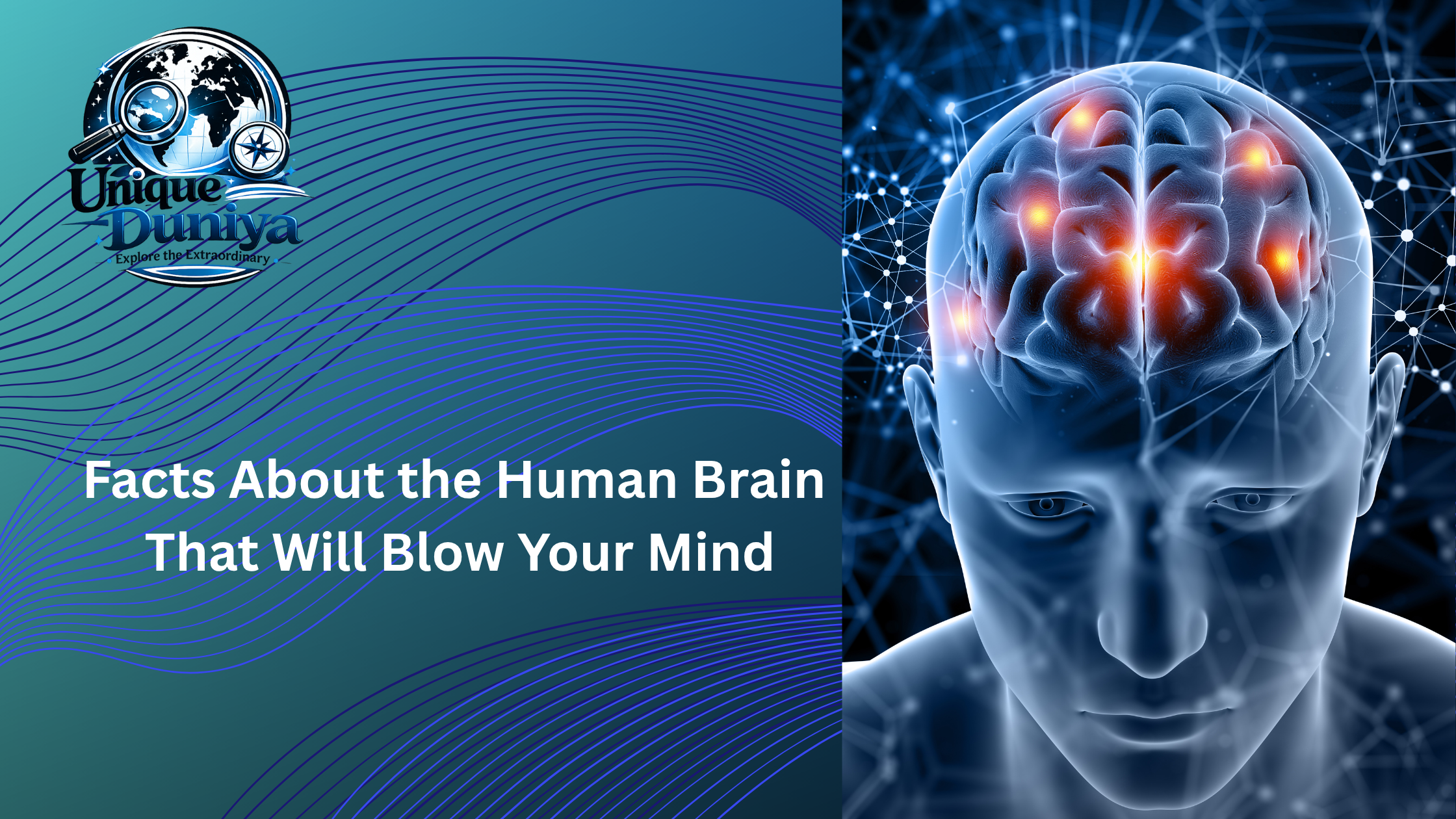
learn the unique facts about human brain
The human brain is one of the most fascinating organs in the body. It controls everything we do, from breathing and thinking to dreaming and remembering. Despite centuries of research, scientists are still discovering new facts about the human brain every year. The more we learn about it, the more incredible it seems.
In this article, we’ll explore some surprising, fun, and even strange things about the brain that you probably didn’t know.
Primary Information About the Human Brain
Let’s start with some truly amazing facts about the human brain.
The adult brain weighs around 3 pounds (1.3 kg). It’s roughly 75% water and about 60% fat, making it the fattiest organ in your body. It has no muscle tissue, yet it runs everything: your heartbeat, your breathing, your emotions, your memories, and your ability to read this sentence right now.
Structurally, there are three human mind parts:
- The cerebrum is the largest section. It handles thinking, language, learning, and voluntary movement.
- The cerebellum sits at the back and bottom. It coordinates balance and fine motor control.
- The brainstem connects the brain to the spinal cord and manages automatic functions like breathing and heart rate.
Together, these human mind parts control your entire existence.
Amazing Facts About the Human Brain
Here are some interesting facts about the human brain.
Your Memory Is Virtually Limitless
The brain’s storage capacity is estimated at around 2.5 petabytes—that’s roughly 2.5 million gigabytes.
The Brain Has Zero Pain Receptors
Brain tissue itself cannot feel pain. There are no nociceptors—pain-sensing nerve endings—inside the brain. This is why neurosurgeons can operate on a patient who is fully awake.
Your Brain Isn’t Fully Developed Until 25
Most people assume the brain finishes growing in the teenage years. It doesn’t. The frontal lobes—the part responsible for planning, reasoning, and impulse control—are the last to mature, and they don’t fully develop until around age 25.
Neural Signals Travel at Up to 268 mph
Information moves through your nervous system fast. Signals can travel at speeds up to 268 miles per hour (431 km/h), depending on the type of nerve fiber.
Memories Are Reconstructed, Not Replayed
The human brain doesn’t store memories like files on a hard drive. Memory is distributed across multiple brain regions—the hippocampus, amygdala, prefrontal cortex, and others. Every time you remember something, you’re actually reconstructing it from pieces.
The Brain Burns 20% of Your Body’s Energy
The brain makes up about 2% of your body weight, but it consumes roughly 20% of your total energy. It demands that energy constantly—whether you’re solving a math problem or sitting quietly doing nothing.
Fun Facts About the Human Brain
Here are some amazing fun facts about the human brain.
It’s Mostly Fat
About 60% of the dry weight of your brain is fat. The myelin sheath—the protective coating around nerve fibers—is largely made of fatty acids. Make sure you feed your mind with healthy fats.
The brain never stops talking
Your brain contains roughly 86–100 billion neurons, and each one can connect to thousands of others. These connections—called synapses—number in the hundreds of trillions. The communication between them happens at speeds up to 268 mph, forming the basis of everything you think and feel.
Your Brain Is More Active When You Sleep
Sleep might look like downtime, but your brain is busy. During sleep, the brain consolidates memories, flushes out waste products through the glymphatic system, and processes emotional experiences.
Laughter Uses Your Whole Brain
When you laugh, it’s not just one region lighting up. Laughter activates the motor cortex, the frontal lobe, and the limbic system simultaneously. That multi-region activation is part of why laughing genuinely lifts your mood.
Scary Facts About the Human Brain
Explore some scary facts about human brain.
Your Brain Will Eat Itself
When the brain is deprived of nutrients—through starvation, extreme dieting, or chronic food restriction—immune cells in the brain called microglia begin to consume synapses. This is called synaptic pruning gone wrong. It’s the brain cannibalizing itself to survive.
You Act Before You Decide
Neuroscientist Benjamin Libet’s famous experiments showed that the brain registers electrical activity about 350 milliseconds before a person consciously decides to make a movement. In other words, your brain initiates action before your conscious mind is aware of the decision. You then feel like you made that choice. Free will gets complicated here.
It Fills in the Blanks—Constantly
Your brain doesn’t give you a perfect picture of reality. It takes in partial sensory data and fills in the rest with assumptions and predictions.
It Can Be Split in Half
Patients with severe epilepsy sometimes undergo a procedure called corpus callosotomy, where the corpus callosum—the thick band of fibers connecting the left and right hemispheres—is cut. The result is two independently functioning hemispheres in the same skull. Each half can have its own preferences, reactions, and even intentions. In some cases, one hand will literally fight the other. Neuroscientists call this “alien hand syndrome.”
Sleep Paralysis Is a System Error
When you dream during REM sleep, your brain shuts down your motor neurons so you don’t physically act out your dreams. It’s a protective mechanism. But sometimes your conscious mind wakes up while that motor shutdown is still active. The result is that you’re aware but completely unable to move. It is is sometimes accompanied by a sense of a presence in the room. It’s not supernatural. It’s just your brain’s off-switch being a few seconds late.
Common Myths About the Human Brain
Let’s debunk some common myths about the human brain.
Myth: We Only Use 10% of Our Brains
Truth: The 10% idea has no scientific basis. Neurologists have never found a dormant 90% waiting to be unlocked.
Myth: Brain Cells Can’t Regenerate
Truth: For most of the 20th century, scientists believed we were born with all the neurons we’d ever have. That’s been overturned. Adult neurogenesis—the growth of new neurons—does occur, particularly in the hippocampus, which handles memory and mood. Exercise, sleep, and certain foods appear to support this process.
Myth: The Brain Deteriorates Inevitably With Age
Truth: Some things do slow down. Processing speed and short-term memory can decline. But many cognitive abilities actually improve with age, like vocabulary, emotional regulation, pattern recognition, and the ability to read social situations.
Myth: Alcohol Kills Brain Cells
Truth: Chronic, heavy drinking is genuinely harmful to the brain—but not by killing neurons outright. What alcohol does is damage the dendrites, the branch-like extensions that allow neurons to communicate with each other.
What Is the 7-Minute Brain Theory?
The “7-Minute Brain Theory” is a concept suggesting that after clinical death, the human brain remains active for approximately seven minutes. In these 7 minutes, the brain experiences a surge of electrical activity. It may replay the person’s life memories, deepest experiences, and thoughts in a final dream-like sequence.
Conclusion
The human brain is one of nature’s greatest achievements. It stores memories, creates ideas, controls movement, regulates emotions, & keeps us alive every second of every day. The more we learn about the brain, the more we realize how extraordinary it truly is. Visit Uniqueduniya.com to explore such interesting facts about the human brain and body.
FAQs
How do you use 100% of your brain?
You already use virtually all areas of your brain. Different regions become active for different tasks. The goal is not to use 100% at once but to keep your brain healthy through learning, exercise, sleep, and mental challenges.
What should you eat to improve brain performance?
Research consistently points to eating fatty fish (for omega-3s); blueberries (antioxidants); leafy greens (folate and vitamin K); nuts, especially walnuts; eggs (choline and B12); and dark chocolate in moderation.
Is 95% of the brain subconscious?
Many psychologists suggest that a large portion of mental processing occurs outside conscious awareness. However, there is no scientific evidence proving that exactly 95% of brain activity is subconscious.
What is the smartest brain age?
There is no single age when the brain is at its smartest. Different abilities peak at different times. Processing speed may peak in early adulthood, while vocabulary, wisdom, and emotional intelligence often improve later in life.
About the Author



loved the explanation
useful information