Rafflesia arnoldii: The World's Largest Flower
Did You Know a Flower Can Be This Large?
Most flowers are small, delicate, and sweet-smelling. You’d expect the world’s biggest one to be something grand — maybe tall, maybe colorful, maybe fragrant.
But Rafflesia arnoldii breaks every expectation.
Rafflesia arnoldii is the most unique flower in the world that doesn’t stand tall. It has no stem, no leaves, no roots. It doesn’t smell like a garden. In fact, it smells like death. And yet, it holds the title of the largest single flower on Earth — a title that no other plant has come close to stealing. There’s still a lot about this bizarre bloom that might surprise you.
What Makes Rafflesia arnoldii the Most Unique Flower in the World?
Rafflesia arnoldii is commonly called the “monster flower” or “corpse flower.” It grows in the rainforests of Southeast Asia, mainly in Sumatra and Borneo, Indonesia.
The numbers are hard to believe. It can grow up to 1 meter (3.3 feet) in diameter and weigh up to 11 kilograms (24 pounds). Research says the single largest specimen ever measured was 1.14 meters (3 feet 9 inches) wide.
The Rafflesia arnoldii flower is famous not only for its size but also for its unique growth process, strong aroma, and role in tropical rainforest ecosystems. It was first discovered in 1818 when British explorer Sir Stamford Raffles and naturalist Dr. Joseph Arnold came across it in the rainforests of western Sumatra. The scientific name honors both men—Raffles and Arnold. It is one of the three national flowers of Indonesia, officially recognized as a national “rare flower” in Presidential Decree No. 4 in 1993.
Key Highlights About Rafflesia arnoldii
Explore what makes Rafflesia arnoldii the most unique flower in the world.
Appearance
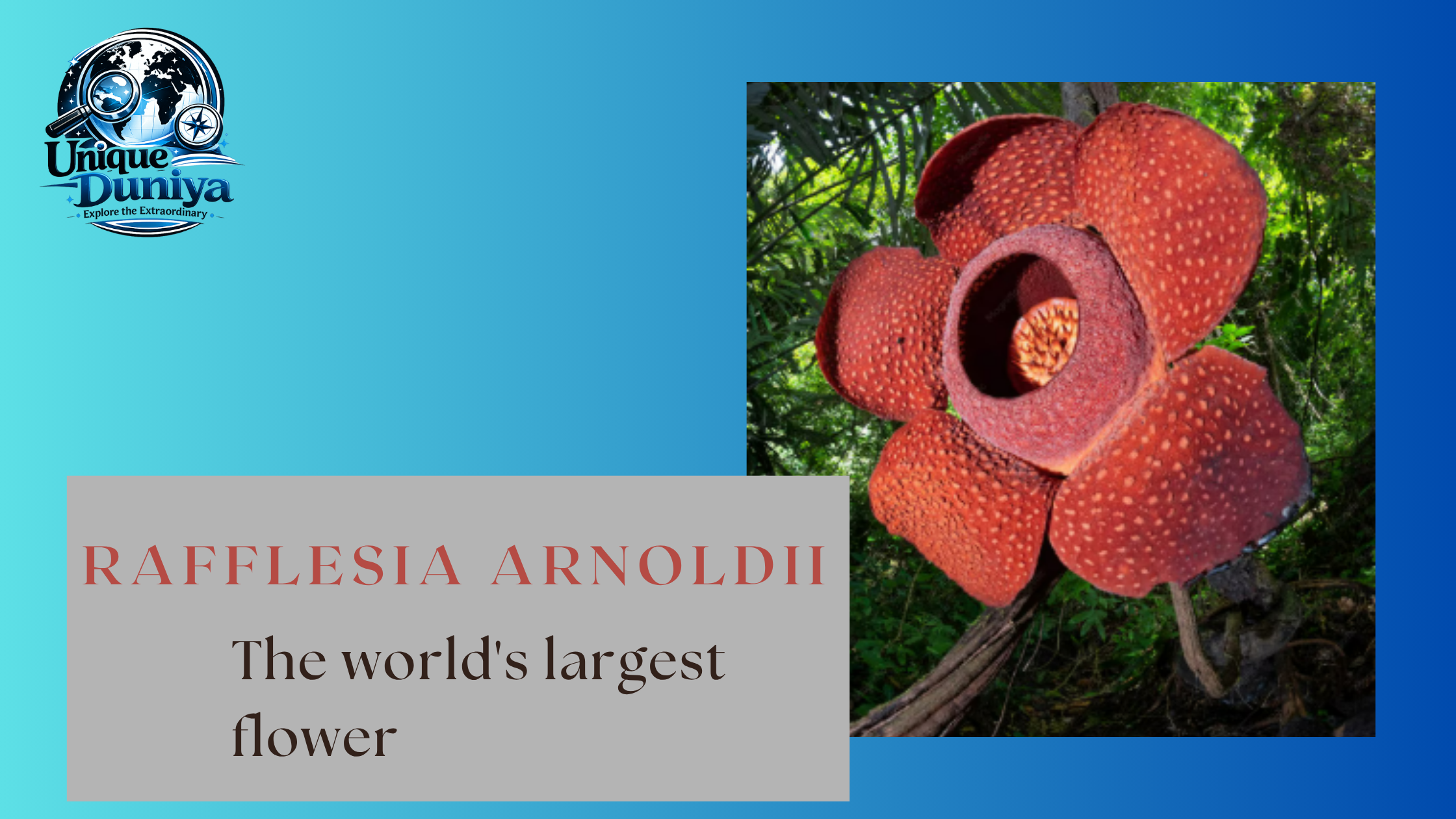
Rafflesia arnoldii looks nothing like what you’d expect from a flower. It has five thick petals colored brick-red or orange with distinctive white spots. In the center, there is a cavity that functions as a collection point for pollen and reproductive organs.
Once it emerges, it sits on the forest floor, looking for all the world like a large orange-red cabbage. Eventually, under the cover of darkness, it slowly unfurls five huge, leathery petals surrounding a deep central cup that contains a formidable-looking set of scarlet spikes. From above, its coloring is a vibrant red with white flecks, resembling something entirely different.
The “Corpse Flower” Scent
Here’s where it gets strange. Rafflesia earned its dark nickname for a very real reason.
The strong odor of decaying flesh is a key adaptation for attracting its pollinators. Chemical studies have shown that this scent is caused by sulfur-containing compounds like dimethyl disulfide and dimethyl trisulfide. These chemicals are also present in decomposing organic matter.
The pungent bouquet is reportedly strongest around noon on the third or fourth day of the bloom. Carrion flies, which are normally attracted to dead animals, swarm to the flower—and in doing so, they pollinate Rafflesia arnoldii. It’s a grim but effective strategy.
No Roots or Leaves
Rafflesia doesn’t look like a plant because, in many ways, it barely functions like one.
The plant has no stems, leaves, or roots. It is a holoparasite of vines in the genus Tetrastigma, spreading its absorptive organ inside the tissue of the vine. The only part of the plant visible outside the host vine is the five-petaled flower.
It lives inside Tetrastigma vines as a mass of fleshy strands that absorb water and nutrients from the host. It takes everything it needs from the vine and gives nothing back. Rafflesia arnoldii is a true botanical freeloader.
Short Lifespan
All of this buildup—months of slow development—leads to a very short grand finale.
Bud development can take up to 9 months, while the flower lasts less than a week. Pollination windows can be as short as 24 to 72 hours. The show is over all too soon; within just three days, the flower can dissolve into a puddle of black slime. The Rafflesia arnoldii flower blooms, stinks, draws in its pollinators, and then it’s gone.
Does Rafflesia Grow in India?
No, it doesn’t. True Rafflesia plants are not found in India.
Rafflesia is endemic to Malaysia, Thailand, Indonesia, and the Philippines. The specific conditions it requires — dense tropical rainforest, the right species of Tetrastigma vine, high humidity, and stable temperatures — aren’t found in the Indian subcontinent.
So if you’re in India and hoping to spot one in the wild, you’d need to plan a trip to Southeast Asia instead.
Can We Touch a Rafflesia?
Technically, yes — touching it won’t harm you. But it’s strongly discouraged, and here’s why.
Ecotourism is thought to be one of the main threats to the species. At locations regularly visited by tourists, the number of flower buds produced per year has decreased. Even walking too close to the plant’s host vine can cause damage.
The flower only blooms for a few days. If you’re lucky enough to witness one, the respectful move is to observe from a distance. These blooms are rare. Some plants only produce one flower every few years. Getting close enough to touch it simply isn’t worth the risk to the plant’s survival.
How Does Rafflesia Smell?
Rafflesia arnoldii smells like a rotting corpse.
The flower emits a vile aroma similar to rotten meat, drawing in insects like flies and beetles that are attracted to dead flesh. It’s not a faint smell either. Local guides in Sumatra and Borneo can often detect a blooming Rafflesia from a considerable distance.
The smell serves a specific biological purpose. Since the flower can’t move, it needs to attract pollinators to it. Carrion flies are drawn to the scent because it mimics the smell of a large, decomposing animal. It is exactly the kind of place they’d normally lay their eggs. The flies visit, pick up pollen, and (if they’re lucky) find another Rafflesia to transfer it to.
Was the Demogorgon Inspired by Rafflesia?
If you’ve watched Stranger Things, you already know the Demogorgon. The terrifying, faceless creature with a flower-petal mouth full of teeth. That design has a real-world botanical inspiration.
The Demogorgon’s open mouth somewhat resembles a Rafflesia arnoldii, a flower with the odor of decaying flesh, earning it the nickname “corpse flower.” The resemblance of the flower to the Demogorgon villains of the Netflix horror series is described as uncanny. The five-petaled, reddish structure with a dark central cavity does look eerily similar to the creature’s face. It’s one of those moments where nature turns out to be stranger than fiction.
Other Giant Flowers to Know
Rafflesia arnoldii holds the record for the largest single flower. But there are a few other massive bloomers worth knowing about.
Titan Arum (Amorphophallus titanum)—Also called the “corpse flower,” Amorphophallus titanum has the largest unbranched inflorescence. It means it’s technically a cluster of thousands of tiny flowers on a single massive stalk, not one single bloom. Unlike Rafflesia arnoldii, the titan arum reaches towering heights of up to 3.7 meters (12 feet). It also produces a foul smell, and it’s frequently grown in botanical gardens where it attracts large crowds when it blooms. The two plants are often confused, but they’re completely unrelated species with very different structures.
Conclusion
Rafflesia arnoldii is unlike anything else in the plant kingdom. No roots, no leaves, no stem. Nine months of hidden growth for just a few days of bloom. A smell that drives away humans and draws in flies. A size that makes it look more like a prop from a science fiction film than a real flower. And yet it’s entirely real, quietly living inside jungle vines in Sumatra and Borneo, waiting for its brief moment to appear.
It’s a good reminder that nature doesn’t always follow the rules we expect. Sometimes the biggest, strangest, most extreme thing in the room is also the one most people have never heard of. If you ever get the chance to see a Rafflesia bloom in the wild, go. Just maybe don’t stand too close — and definitely don’t touch it.
Visit Unique Duniya to explore such amazing animal and plant life.
FAQs
What flower takes 7 years to bloom?
The Titan Arum (Amorphophallus titanum), also known as the “corpse flower,” can take anywhere from 7 to 10 years to produce its first bloom. After that, it may bloom only once every few years.
What flower is called God’s perfume?
Jasmine is known as “God’s perfume.” Its sweet, intense fragrance has made it a symbol of purity and divine grace across many cultures, particularly in South and Southeast Asia.
What is the rarest flower in the world?
The Middlemist Red (Camellia japonica ‘Middlemist’s Red’) is widely considered the rarest flower in the world. Only two known specimens exist — one in a garden in New Zealand and one in the UK. It was brought from China to Britain in 1804 by horticulturalist John Middlemist and has since disappeared entirely from its native country.
About the Author




Sprawdz najlepsze [url=https://www.kasyna-pl-bez-depozytu.pl/]kasyno z bonusem bez wplaty[/url], ktore oferuja wyjatkowe promocje dla nowych graczy.
Rynek kasyn internetowych dynamicznie sie rozwija, oferujac coraz atrakcyjniejsze bonusy bez depozytu.
В отношениях общий интерес способен усиливать взаимопонимание и становиться основанием для откровенного диалога о фантазиях и границах.
הפורטל הזה מציע מבחר רחב של תכנים המותאמים למשתמשים הישראלי.
כאן תוכלו למצוא חוויות מגוונים בתחום המבוגרים באיכות מעולה.
האתר מאפשרת גישה קלה לתכנים אלו תוך הקפדה על אנונימיות הגולש.
https://hasfaniyot.net/